| Date | Location | Landscape Guide Focus |
|---|---|---|
| 2024-01-30 | Kenora | Boreal |
| 2024-02-01 | Dryden | Boreal |
| 2024-02-06 | Thunder Bay | Boreal |
| 2024-02-13 | Timmins | Boreal |
| 2024-02-15 | Hearst | Boreal |
| 2024-02-22 | Peterborough | Great Lakes-St. Lawrence |
| 2024-02-28 | Virtual | Boreal & Great Lakes-St. Lawrence |
| 2024-03-05 | Sault Ste Marie | Great Lakes-St. Lawrence |
| 2024-03-07 | North Bay | Boreal & Great Lakes-St. Lawrence |
| 2024-03-12 | Bracebridge | Great Lakes-St. Lawrence |
1 Background
This report presents the findings and conclusions of the ten-year reviews of the Forest Management Guide for Boreal Landscapes (OMNR 2014) and the Forest Management Guide for Great Lakes-St. Lawrence Landscapes (OMNR 2010). In this document, these guides are referred to as Boreal Landscape Guide (BLG) and Great Lakes-St. Lawrence Landscape Guide (GLSL LG), respectively. Collectively, this document refers to these guides as “the landscape guides”).
1.1 Policy context
The Ministry of Natural Resources (MNR) maintains a suite of forest management guides as a part of Ontario’s forest policy and management frameworks. These guides provide direction used by planning teams during the development of forest management plans.
The Forest Operations and Silviculture Manual (FOSM) 2020 is regulated under the Crown Forest Sustainability Act and requires forest management guides to be reviewed at least once every ten years. The BLG was published in 2014, and this is the first review of the guide. The GLSL LG was published in 2010, reviewed in 2015, and this is the second review of the guide.
The review of a forest management guide is part of the adaptive management approach described in FOSM, and is intended to inform whether revisions to the guide are warranted. This manual directs that the reviews will consider:
Results of applicable scientific investigations
Results of monitoring programs
Feedback from practitioners, Indigenous peoples, and stakeholders
Advances in technology and changes to operational practices
These points of consideration were incorporated into the landscape guide reviews. Emphasis was placed on seeking feedback from practitioners, First Nation peoples, Métis peoples and stakeholders, given the recent implementation of the landscape guides in forest management planning.
1.2 Landscape guide implementation
The objective of the landscape guides is to direct forest management activities to maintain or enhance natural landscape structure, composition and patterns that provide for the long-term health of forest ecosystems in an efficient and effective manner. These guides direct the amount and arrangement of different types and ages of forest on the landscape. The landscape guides, as well as the Forest Management Guide for Conserving Biodiversity at the Stand and Site Scales, incorporate a coarse and fine filter concept in the direction for forest management. In addition to landscape level direction, the BLG also includes stand and site level direction for caribou. Therefore, workshops held in context of the BLG included topics specific to the stand and site level direction for caribou.
Since the release of the landscape guides in 2010 (GLSL LG) and 2014 (BLG), all forest management units have fully incorporated landscape guide direction into their forest management plans. Section 1.4 of the landscape guides identifies how direction in these guides were expected to be incorporated in forest management planning, including a set of phase-in provisions for different stages of planning. Some forest management plans applied the theory and science supporting the landscape guides prior to their release, as an effort to include the best science and information available, as specified in the Forest Management Planning Manual. This application of the science and information products supporting the landscape guides was also part of pilot testing the landscape guides.
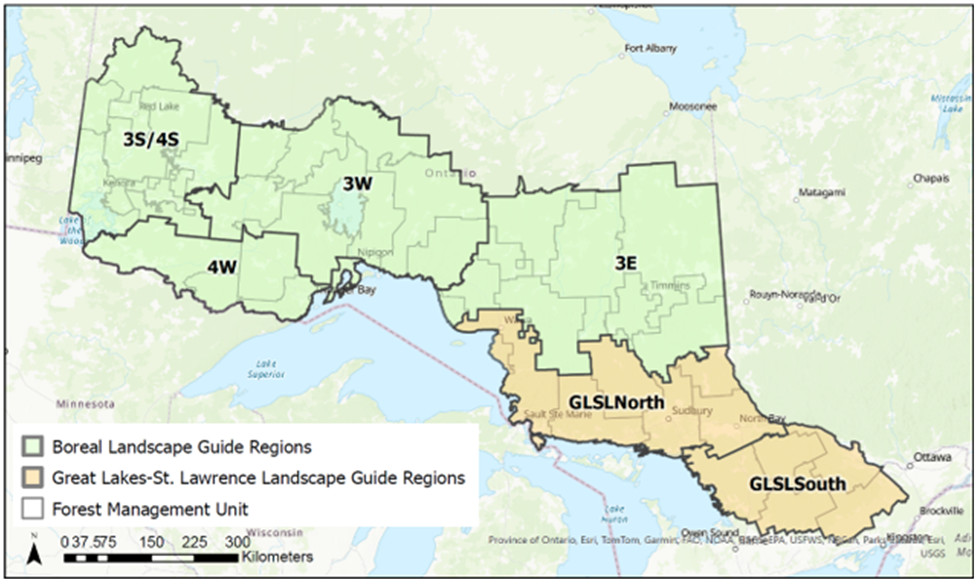
Figure 1.1 is an illustration of the landscape guide regions identified in the current landscape guides. The forest management unit boundaries (2024) are displayed within the landscape guide regions and identify which landscape guide was applied in planning. A more detailed map including labelled forest management units is included in Appendix A. A complete list of forest management plans and their effective dates can be found on the Ontario webpage.
1.3 Structure of the landscape guide reviews
The review for each landscape guide followed a similar structure as the 2015 GLSL LG review, which can be found in the Science and Information Package for Great Lakes-St. Lawrence. Practitioners, First Nation peoples, Métis peoples, and stakeholders were engaged in the reviews through a series of information sessions and workshops. There was also an online survey provided to participants and an offer to engage with specific groups or communities in separate meetings or formats (e.g., written feedback).
The engagement and workshops for both landscape guides were held concurrently to facilitate efficiencies in receiving feedback from practitioners, First Nation peoples, Métis peoples and stakeholders. Some practitioners have experience applying both landscape guides. The content of both guides is based on the same theory and have similar direction. Structuring the workshops to discuss both landscape guides concurrently also supported discussions about aligning the timeframe of any potential revisions and the consideration for amalgamating the guides, which was a recommendation in the 2015 GLSL LG review.
Invitations for the information sessions and workshops were sent to First Nation communities and organizations, Métis communities and organizations, stakeholders, practitioners, government staff, and other interested individuals. The information sessions were held virtually through MS Teams on January 23rd and 24th, 2024. The intent of these sessions was to provide an overview of the landscape guides and information about the review, timelines, and in-person workshops. These sessions provided an opportunity for individuals to ask questions about the review process and the content and format of the workshops, which also informed participant interest in attending a more technical workshop. A recording of the information session was made available upon request.
Nine in-person workshops and one virtual workshop were hosted between January 30th and March 12th, 2024. Table 1 lists the workshop dates and locations, as well as the landscape guide(s) that were the focus of each workshop. The workshops were technical in nature and focused on seeking feedback about the implementation of the landscape guides. The intended audience was individuals who are familiar with the landscape guides and have experience with their application (e.g., forest management planning team members). The structure of the workshop included a detailed review of direction in the landscape guide(s), four activities, and time to reflect on the day. A summary of the activities and workshop discussion is provided in section 2.
The online survey was hosted on MS Forms and made available between January 25th and March 29th, 2024, with some requests for extension. The survey included questions about guide implementation, science supporting the landscape guides, effectiveness and effects of guide direction, climate change, and caribou habitat (where applicable). Some participants opted to provide written feedback and/or meet with the MNR to provide comment. More details about each section of the survey and a summary of responses and written feedback is provided in section 2.
Other considerations in the review were current literature and approaches in other jurisdictions, reporting and audits, scientific investigations and monitoring programs, and advances in technology and changes to operational practices. Details on this information are described in section 3.
1.4 Provincial Forest Technical Committee
As per the FOSM, the Provincial Forest Technical Committee (PFTC) provides advice on the review and revision of forest management guides. Advice from PFTC is intended to ensure the direction reflects current scientific knowledge and forest management practices and that the direction can effectively and efficiently achieve the purposes identified in the Crown Forest Sustainability Act.
The PFTC was involved in the original development and review of the current landscape guides. For the 2024 landscape guide reviews, the PFTC was presented and provided feedback on the review approach at an early stage of preparing for the workshops. Some PFTC members participated in the information session and workshops supporting the review. The PFTC also received a presentation summarizing preliminary results from the workshops and provided input on next steps for the reviews.